SCFHS Classification Process Explained: What Happens Before and After the Consultant Interview
-

MBBS, MS, MRCS, M.Ch(GI), FRCS (Transplant Surgery), MFSTEd, CESR (UK) – HPB & LT Consultant HPB, Multi-organ Transplant & Robotic Surgeon
Share this Blog
Key Takeaways: At a Glance
- Professional classification and professional registration are two distinct processes. Classification determines your professional category. Registration is the subsequent step that permits you to practice in Saudi Arabia and requires lawful residence in the Kingdom. Classification can be completed from outside the Kingdom. Registration cannot, it requires lawful residence, typically an Iqama linked to a valid employment contract.
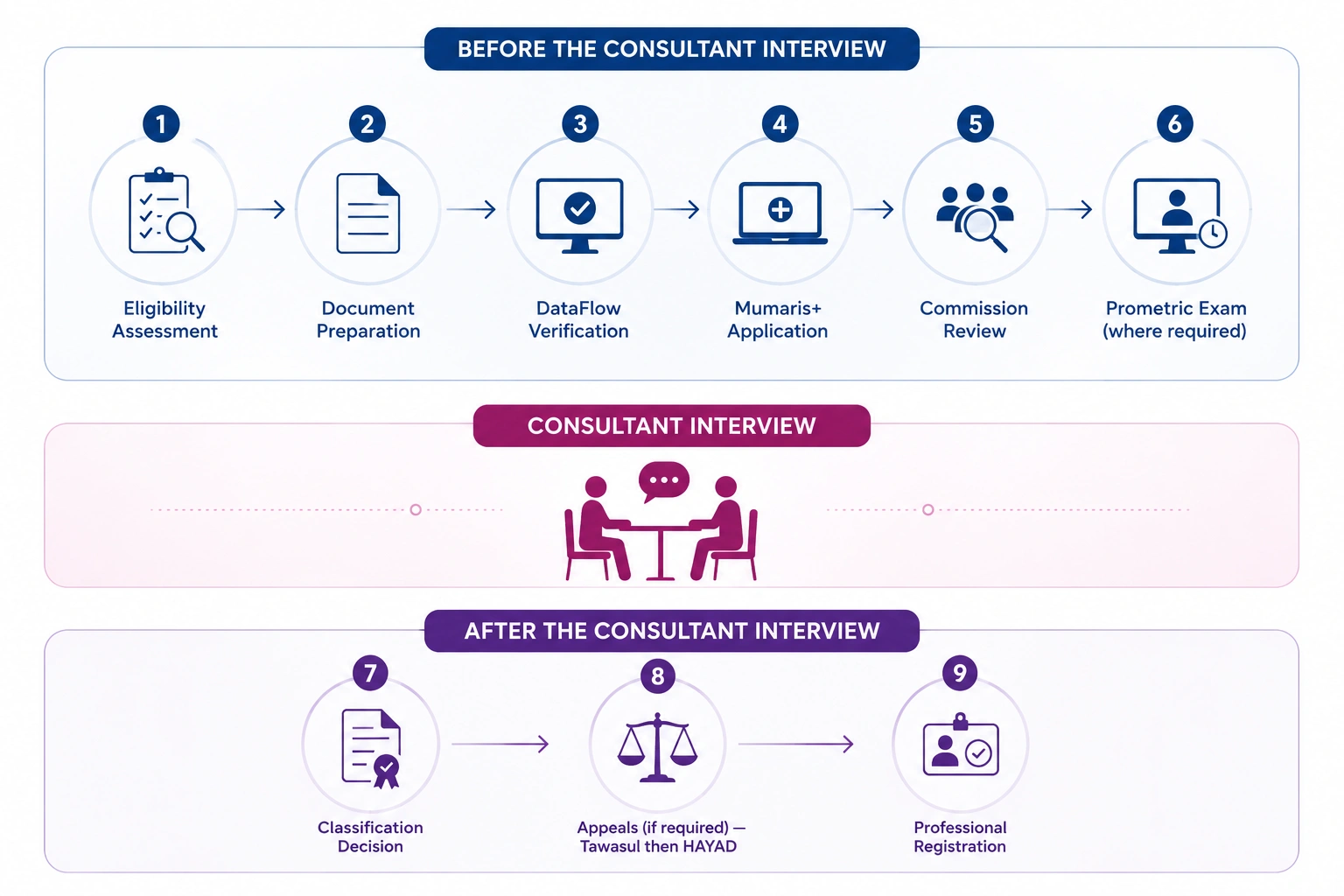
- The classification journey runs through a defined sequence: eligibility assessment, document preparation, DataFlow verification, Mumaris+ application, Commission review, professional assessment where required, and the Consultant Interview.
- Not all applicants are required to sit the written Prometric exam. The assessment route is determined based on the applicant’s qualification, experience, specialty, and the result of its initial review.
- After the Consultant Interview, the classification result is published in Mumaris+. If you wish to contest the outcome, a formal objection process is available through Tawasul, followed by a grievance route through the HAYAD service within 60 days.
- DataFlow Primary Source Verification takes 6 to 10 weeks to complete and must be passed before classification can proceed. Starting DataFlow before beginning Prometric preparation is the single most effective way to prevent it from becoming a bottleneck between your exam result and your classification outcome.
- The complete classification journey runs through 11 defined steps from eligibility to registration. The full sequence is summarised at the end of this article.
Introduction
Saudi Arabia’s healthcare sector is expanding at a significant pace under Vision 2030, with a strong emphasis on workforce quality and competency-based professional standards. For international General Surgery consultants, entering this system begins with a regulated classification process administered by the Saudi Commission for Health Specialties (SCFHS), the sole regulatory body for all healthcare practitioners in the Kingdom.
This guide is written by Mr Manikandan Kathirvel, Consultant HPB and Liver Transplant Surgeon and PrepMedico’s lead SCFHS faculty, based on direct experience preparing General Surgery Consultant candidates through the classification process across 5 cohorts. The procedural details, timeline estimates, and common delay patterns described here reflect what candidates encounter in practice, cross-referenced against SCFHS’s published classification guidelines.
The classification process is not a single examination. It is a sequential administrative and assessment pathway that begins before you book any exam and continues after your interview result is issued. Understanding the full sequence, and where the Consultant Interview sits within it, is essential for planning your timeline, preparing your documents, and avoiding the delays that most commonly set candidates back.
This guide covers the complete classification journey for General Surgery Consultant applicants, from eligibility through to registration.
PrepMedico supports General Surgery Consultant candidates through the assessment stages of this journey, from Prometric preparation through to Consultant Interview readiness, with structured courses, digital resources, and faculty who have direct experience of the SCFHS classification pathway.
What the Classification Process Is and What It Is Not
Classification is not the same as registration. According to the Commission, professional classification is the process of granting the appropriate professional category to a healthcare practitioner based on a sequential review of qualifications, experience, and professional assessment. Professional registration is a separate, subsequent process that saves the practitioner’s data in the Commission’s database and permits them to practice in the Kingdom. Registration requires lawful residence in Saudi Arabia and is valid for two years. You cannot register without first being classified.
Classification is not a single assessment. SCFHS assesses applicants through one of three routes: a direct decision, a practical evaluation, or a written electronic examination. The oral Consultant Interview is an additional assessment that applies to specific applicants, including General Surgery Consultant candidates, within the classification framework. The route assigned depends on your qualification, specialty, experience, and SCFHS’s review of your application.
Stage 1: Eligibility and Professional Category
The classification journey begins with establishing what you are applying for. For General Surgery candidates seeking Consultant classification, the starting point is confirming that your qualifications and experience meet the SCFHS eligibility criteria for that category.
The Commission determines professional category, General Practitioner, Specialist, or Consultant, based on the nature and level of the applicant’s qualification and their verified clinical experience. Applying for the correct category from the outset is important. Submitting an application for a category your credentials do not support results in a returned or declined application and delays the entire process.
Candidates holding postgraduate qualifications from certain countries or specialty boards may be eligible for a modified assessment route. The specific route is determined case by case through SCFHS’s credential review, no blanket exemption applies based on the country of training alone. Candidates with UK FRCS, US board certification, or equivalent qualifications should verify their specific route through the Mumaris+ portal before assuming any exemption applies.
For a detailed breakdown of the eligibility requirements for General Surgery Consultant classification, refer to the eligibility criteria guide.
Stage 2: Document Preparation
Before submitting an application through Mumaris+, applicants must prepare a complete set of documents. Incomplete or incorrectly formatted submissions are one of the most common causes of application delays.
The core documents required for a General Surgery Consultant classification application include:
- Primary degree certificate and academic transcript
- Postgraduate qualification (Fellowship, Board, FRCS, or equivalent) with program description and completion date
- Professional registration certificate from the applicant’s country of practice, issued by the relevant licensing authority
- Experience letters from each employer, confirming the clinical role, specialty, dates, and full-time status, issued on official letterhead
- Valid passport
Documents issued outside Saudi Arabia in languages other than Arabic or English must be accompanied by official translations. Experience letters that lack specific clinical detail, such as job title, specialty, and confirmation of clinical practice rather than administrative or training roles, are frequently returned by SCFHS for correction.
Stage 3: DataFlow Primary Source Verification
Primary Source Verification (PSV) is required for qualifications and professional credentials issued outside Saudi Arabia. This verification is conducted by the DataFlow Group, an independent company contracted by SCFHS for this purpose.
DataFlow contacts the issuing institutions directly, universities, medical boards, licensing councils, and employers, to confirm that the documents submitted are genuine and accurately represent the applicant’s qualifications and experience. It is not document attestation. It is independent verification from the original source.
DataFlow’s stated processing target is 15 to 25 working days from a complete document submission. In practice, most applicants should allow 6 to 10 weeks to account for delays in institutional responses, universities and licensing bodies in some countries take several weeks to respond to DataFlow’s verification requests. The 15 to 25 working day figure reflects DataFlow’s processing of documents once institutional responses are received, not the total elapsed time from your initial submission.
Three points are important to understand about DataFlow in the classification context:
- A positive DataFlow report is a prerequisite for classification. The Commission will not proceed without it.
- A positive DataFlow report does not itself guarantee Consultant classification. It confirms the authenticity of your credentials. The classification decision is made by SCFHS based on its assessment of those credentials.
- Starting DataFlow early, ideally before beginning Prometric preparation, prevents it from becoming a bottleneck between your exam result and your classification outcome.
For a full breakdown of the DataFlow process, documents, fees, and timelines, see PrepMedico’s SCFHS DataFlow verification guide.
Stage 4: Mumaris+ Application
Mumaris+ is the unified digital platform through which SCFHS manages all classification, registration, and licensing services. The portal is available at mumaris.sa. Every step of the classification process, from document submission to exam scheduling and certificate access, runs through this portal.
For the classification application, Mumaris+ is where you:
- Select the classification service appropriate to your professional category
- Complete your professional profile and personal information
- Upload your documents into the designated slots
- Pay the classification service fee
- Receive requests for additional information or clarification
- Track the progress of your application
- Receive your classification result and access your certificate
The portal is accessible from outside Saudi Arabia. Applicants can initiate and progress their classification without being in the Kingdom.
Once your classification application is approved, the certificate can be printed directly from the My Certificates section of your Mumaris+ account. For step-by-step guidance on creating a Mumaris+ account and completing your profile, see PrepMedico’s Mumaris+ registration guide.
The portal interface is primarily in Arabic. English-language guidance on navigating key sections of Mumaris+ is available through SCFHS customer service and through PrepMedico’s Mumaris+ registration guide.
Stage 5: Commission Review and Assessment Route
Once your application and DataFlow report are submitted, the Commission reviews your credentials and determines the assessment route. According to published classification guidelines, there are three possible routes:
- Direct decision: The Commission determines the classification without requiring a further assessment. Processing time is 7 working days.
- Practical evaluation: A structured assessment of the applicant’s clinical or practical competency. Processing time is 35 working days.
- Electronic written examination: The Prometric or Pearson VUE exam, which assesses clinical knowledge and reasoning. Processing time is 30 working days.
The factors that most commonly determine the assessment route for General Surgery Consultant applicants are: the country and institution where the primary degree was obtained, the nature and level of the postgraduate qualification, the number of verified years of clinical experience, and whether the specialty is classified as a shortage specialty within the Kingdom. Candidates with recognised Fellowship qualifications from the UK, Ireland, or equivalent institutions are more likely to receive a direct classification decision, though this is not guaranteed and is assessed case by case.
For General Surgery Consultant applicants, the classification process includes the oral Consultant Interview as part of the professional assessment. The written Prometric exam may also be required as a preceding gate before the interview is scheduled.
Does Every Consultant Applicant Sit the Prometric Exam?
Not necessarily. The assessment route is assigned based on the applicant’s qualification, specialty, experience, and the outcome of the initial credential review. Some applicants may receive a direct classification decision without requiring a written examination. Others may be required to sit only the Prometric, only the oral interview, or both in sequence.
For most General Surgery Consultant applicants from international training backgrounds, the standard route involves the Prometric written exam followed by the oral Consultant Interview. However, this is not universal. The specific route applicable to your application is determined by SCFHS and communicated through your Mumaris+ account.
For a detailed comparison of the two assessments, see our guide to the SCFHS Prometric exam vs Consultant Interview.
The assessment route assigned to your application is communicated through your Mumaris+ account following the Commission’s review of your credentials. If your route is unclear after submission, the SCFHS helpline and Tawasul ticketing system are the correct channels for clarification, not third-party agents or online forums.
Stage 6: The Prometric Exam
Where the written examination is required, it must be passed before the Consultant Interview can be scheduled. The Prometric exam for General Surgery is a 150-question, 3-hour computer-based MCQ assessment covering acute surgery, elective surgery, perioperative management, and patient safety. The result is Pass or Fail. Candidates are permitted a maximum of three attempts. A failed third attempt requires a formal SCFHS review before reapplication is permitted, there is no automatic right to a fourth sitting.”
For General Surgery Consultant applicants who are required to sit the Prometric, the written exam is a significant preparation commitment. A structured 10-week preparation plan, starting with a baseline mock exam and building through high-yield topic areas in order of question weight, is the recommended minimum. Candidates who treat the Prometric as a straightforward MCQ test and prepare without a syllabus-weighted plan consistently underperform. The exam tests clinical reasoning, not recall, and preparation must reflect that distinction from the first week.
For a structured 10-week preparation plan for the Prometric, see our General Surgery Prometric study guide.
Stage 7: The Consultant Interview
The Consultant Interview is the oral professional assessment that determines Consultant classification. According to SCFHS, the oral examination for professional practice aims to evaluate the practitioner’s professional competency safely and independently for the classification level sought. It is conducted by field experts and may be accompanied by assessment of basic specialty-related skills.
The interview is conducted via Zoom, in two sessions with a panel of senior General Surgery consultants appointed by SCFHS. It covers four domains: clinical reasoning, ethical decision-making within the Saudi healthcare context, non-clinical professional competencies, and communication under observation.
The classification decision is made following the interview. The result is published in Mumaris+ within approximately 14 working days of the examination, according to the Commission’s published FAQ.
For a detailed breakdown of the domains and preparation approach for the Consultant Interview, see our General Surgery Consultant Interview questions guide.
After the Consultant Interview: Classification Outcomes
Following the interview, the Commission reviews the assessment and issues a classification decision. The possible outcomes are:
- Classification confirmed at the sought level: The applicant is classified as Consultant. The classification certificate becomes available in Mumaris+.
- Classification confirmed at a lower level: The applicant is classified at a category below Consultant, typically Specialist. This is a formal classification decision, not a failure in the same sense as a failed written examination. It carries its own implications for employment and practice in the Kingdom. A Specialist classification rather than Consultant classification affects the roles you can be offered in Saudi Arabia, your salary band, and your scope of clinical practice. Some employment contracts are specifically conditional on Consultant classification, candidates in this situation should review their offer documentation carefully before pursuing an appeal.
- Application referred for further review or reapplication: The classification is not approved at the current stage. Where further attempts are permitted under the Commission’s regulations, the applicant will be asked to pay the relevant evaluation fees and will be scheduled for a further oral examination. Where no further attempts are permitted, the application is forwarded to the classification department for review.
No fixed universal waiting period applies between an unsuccessful oral examination and a further attempt. The applicable timeline depends on SCFHS’s regulations for the applicant’s specific category and the circumstances of the application.
How to Contest an SCFHS Classification Decision: Tawasul and HAYAD
A formal two-stage process is available for contesting a classification decision.
Step 1: Tawasul objection. The applicant first raises an objection through the Tawasul electronic ticketing system with the relevant SCFHS department. This must precede any formal grievance submission.
Step 2: HAYAD grievance. If the Tawasul objection does not resolve the matter, a formal grievance may be submitted through the HAYAD electronic grievance service. According to SCFHS’s published HAYAD guidelines, the grievance must be submitted within 60 days of becoming aware of the contested decision. The applicant must have a direct interest in the decision and must not have a pending court case on the same matter.
HAYAD submissions are reviewed by the Commission’s permanent grievance committee. The service covers classification decisions, professional registration decisions, and decisions on training programme admission, among others.
SCFHS does not publish a fixed processing timeline for Tawasul or HAYAD submissions. Candidates should initiate the Tawasul objection as soon as possible after receiving an adverse decision, particularly given the 60-day HAYAD window, and follow up through the portal if no response is received within 15 working days.
After Classification: Professional Registration
Classification confirms your professional category. It does not by itself authorise you to practice in Saudi Arabia. Practice authorisation comes through professional registration, a separate process that follows classification.
Professional registration records the practitioner’s data in the Commission’s database and is the step that permits legal clinical practice in the Kingdom. It requires lawful residence in Saudi Arabia, typically supported by a valid employment contract and Iqama, and must be completed after an employer offers a position. Registration is valid for two years and must be renewed through Mumaris+ before expiry. Registration must be renewed through Mumaris+ before the two-year expiry date. Lapsed registration affects the practitioner’s legal right to practice and must be rectified before returning to clinical work, candidates should set a reminder well in advance of the renewal date.
The distinction between classification and registration matters for planning. Classification can be obtained from outside the Kingdom. Registration cannot. The typical sequence for international applicants is: achieve classification, secure an employment offer, arrive in the Kingdom, and then complete registration. Iqama processing timelines vary by employer and circumstance — candidates should factor this into their overall timeline planning and not assume they can complete registration immediately upon arrival. Attempting to compress or bypass this sequence is one of the most common causes of avoidable delays.
The Complete SCFHS Classification Sequence: All 11 Steps
For clarity, the full journey from eligibility to registration follows this sequence:
- Confirm eligibility and target professional category
- Prepare and compile required documents
- Create Mumaris+ account and submit classification application
- Complete DataFlow Primary Source Verification
Note: DataFlow verification should be initiated as early as possible, ideally before or in parallel with the Mumaris+ application submission, not after it. DataFlow can take 6 to 10 weeks, and waiting until after Mumaris+ submission to begin adds avoidable delay to the overall timeline. - Commission reviews credentials and assigns assessment route
- Sit the Prometric written exam, where required
- Sit the Consultant Interview oral assessment
- Receive classification result through Mumaris+
- If applicable: contest the outcome through Tawasul and HAYAD within 60 days.
- Secure employment offer and arrive in Saudi Arabia
- Complete professional registration through Mumaris+
Conclusion
The classification process is a sequential, structured pathway with defined stages and a clear distinction between classification and registration. Understanding where each stage sits, what it requires, and how it connects to the next step allows General Surgery Consultant applicants to plan their timeline realistically, prepare the right documents from the start, and avoid the delays that most commonly set applications back.
The Consultant Interview is the professional assessment stage that sits toward the end of this pathway, not a standalone exam, but the culmination of a process that begins with document preparation and ends with practice authorisation in the Kingdom.
Candidates who have prepared through PrepMedico’s SCFHS General Surgery programme have achieved a 100% Recommended classification rate across 5 cohorts of General Surgery Consultant applicants.
PrepMedico’s SCFHS General Surgery programme covers the two assessment stages of this journey, Prometric preparation and Consultant Interview readiness, and is designed to be started immediately after DataFlow verification is initiated, running in parallel with the administrative stages rather than after them.
Preparing for the Consultant Interview in General Surgery?
PrepMedico’s SCFHS General Surgery course is a structured, mentorship-based programme built specifically for General Surgery Consultant candidates. It picks up where the Prometric ends and prepares candidates for the oral assessment that determines Consultant classification.
If you are currently at the DataFlow or Mumaris+ stage, it is not too early to begin planning your preparation for the Prometric and Consultant Interview. Candidates who start structured preparation early, rather than after their DataFlow clears, arrive at the exam stages with more time and less pressure.
- Saudi faculty-led sessions from active consultants practising within KSA
- Mock interviews modelled on the Consultant Interview format with structured examiner feedback
- Mentor-led preparation with one-to-one and small-group sessions
- UK-based Consultant Surgeon faculty with global interview mentoring experience
- Ethical scenario preparation specific to the Saudi healthcare context
- Recorded lectures, viva practice sessions, and digital library access via app
Explore PrepMedico’s SCFHS General Surgery Consultant Interview Course, structured preparation from Prometric to interview, with Saudi and UK faculty. [View the course and upcoming dates →].
Frequently Asked Questions
Professional classification is the process by which the Commission reviews your qualifications and experience and assigns you a professional category, such as General Practitioner, Specialist, or Consultant. Professional registration is the subsequent step that records you in the Commission’s database and permits you to legally practice in the Kingdom. Registration requires lawful residence in Saudi Arabia and is valid for two years. You cannot register without first being classified.
Yes. Classification applications can be submitted from outside the Kingdom through the Mumaris+ portal. A valid work permit or residence in Saudi Arabia is not required at the classification stage. Professional registration, however, requires lawful residence in the Kingdom and typically follows after an employment contract has been secured.
The timeline varies depending on the assessment route assigned. A direct classification decision takes approximately 7 working days. A route involving the written Prometric exam takes approximately 30 working days from the assessment stage. The oral Consultant Interview route takes approximately 14 working days from the interview for the result to be published in Mumaris+. DataFlow verification adds 6 to 10 weeks before classification can begin. Most General Surgery Consultant applicants should plan for a total classification timeline of 6 to 10 months from document preparation to final result.
Not necessarily. The Commission determines the assessment route—direct decision, practical evaluation, or written examination—based on the applicant’s qualification, specialty, experience, and the result of its initial credential review. Some applicants may receive a direct decision without a written exam. However, for most General Surgery Consultant applicants from international training backgrounds, the written Prometric examination precedes the oral Consultant Interview.
Where further attempts are permitted under the Commission’s regulations, you will be asked to pay the relevant evaluation fees and will be scheduled for an additional oral examination. Where no further attempts are permitted at that stage, the application is referred to the classification department for review. There is no fixed universal waiting period. The applicable timeline depends on the regulations for your specific professional category and circumstances. If you wish to contest the outcome, you may raise an objection through Tawasul followed by a HAYAD grievance within 60 days of becoming aware of the decision.
A two-stage formal process is available. First, raise an objection through the Tawasul electronic ticketing system with the relevant Commission department. If this does not resolve the matter, submit a formal grievance through the HAYAD electronic grievance service on the Commission’s website. The grievance must be filed within 60 days of becoming aware of the contested decision. HAYAD submissions are reviewed by the Commission’s permanent grievance committee and cover classification decisions, registration decisions, and training programme admission decisions.
Professional registration follows classification and requires lawful residence in Saudi Arabia, typically an Iqama linked to a valid employment contract. The standard sequence for international applicants is: achieve classification, secure an employment offer from a Saudi institution, enter the Kingdom, and then complete registration through Mumaris+. Registration cannot be completed from outside the Kingdom. Registration is valid for two years from issuance and must be renewed through Mumaris+ before expiry to maintain legal practice authorisation.
DataFlow’s stated processing target is 15 to 25 working days from a complete document submission. In practice, most applicants should allow 6 to 10 weeks to account for delays in institutional responses, as universities and licensing bodies in some countries may take several weeks to respond to DataFlow’s verification requests. Common causes of delay include discrepant name details across documents, non-responsive institutions, incomplete employment records, and low-quality document scans. Starting DataFlow early, ideally before beginning Prometric preparation, is the most effective way to prevent it from becoming a bottleneck between your exam result and your classification outcome.
Mumaris+ is the unified digital platform through which SCFHS manages all classification, registration, and licensing services. It is accessible from outside Saudi Arabia at mumaris.sa. Every step of the classification process, from document submission to exam scheduling, result publication, and certificate access, runs through this portal. For step-by-step guidance on creating your account and completing your professional profile, see PrepMedico’s Mumaris+ registration guide.