SCFHS General Surgery Consultant Interview Questions: Important Areas to Prepare
-

MBBS, MS, MRCS, M.Ch(GI), FRCS (Transplant Surgery), MFSTEd, CESR (UK) – HPB & LT Consultant HPB, Multi-organ Transplant & Robotic Surgeon
Share this Blog
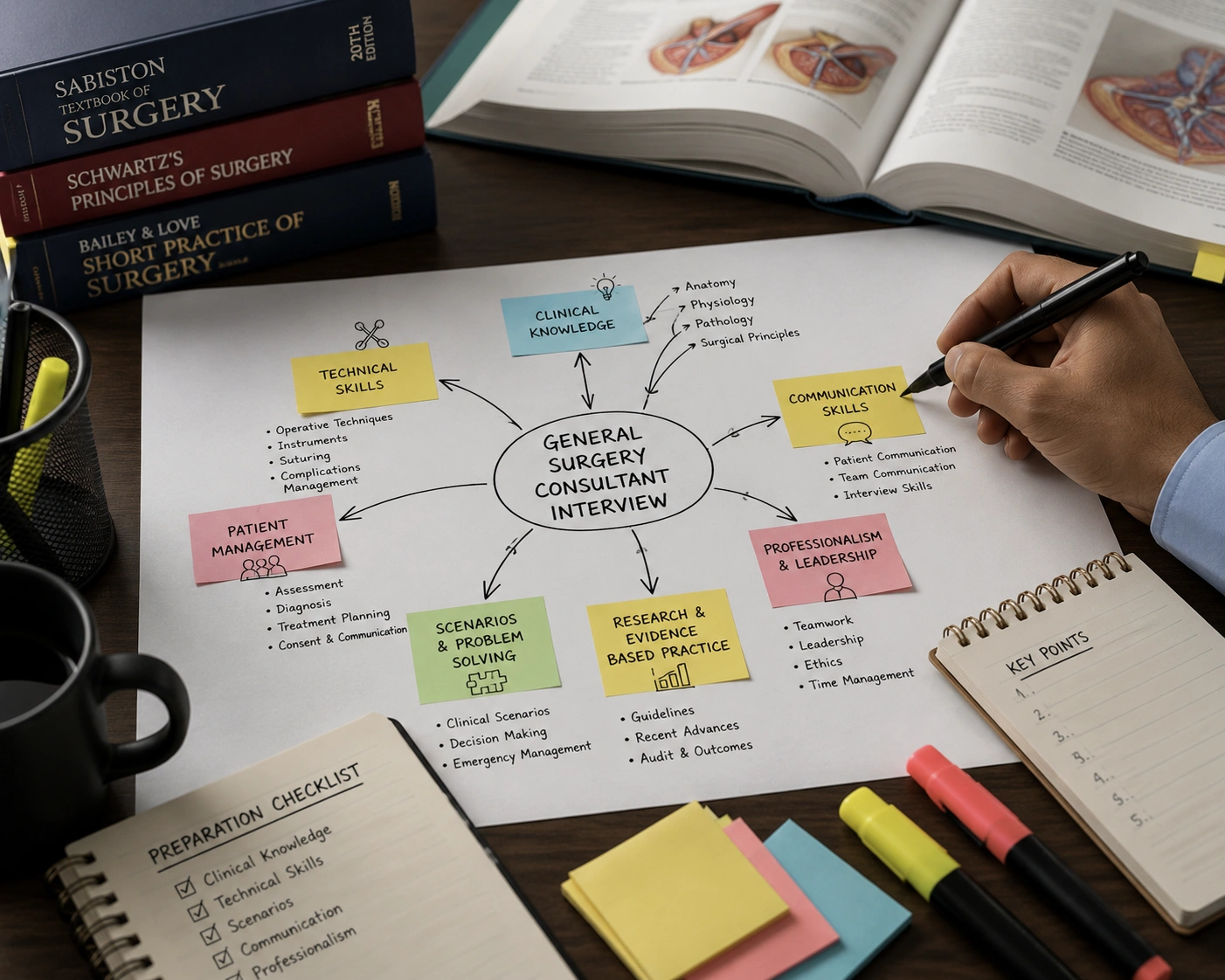
Key Takeaways: At a Glance
- The Consultant Interview is a two-session, 60-minute oral assessment conducted via Zoom by a panel of 2 to 4 senior General Surgery consultants appointed by SCFHS.
- Questions span four domains: clinical reasoning, ethical decision-making within the Saudi healthcare context, non-clinical professional competencies, and communication under observation.
- The ethical domain is not generic medical ethics. It is specifically framed within Saudi Arabia’s cultural, legal, and religious framework, including Islamic ethics, family-centred consent, and local clinical governance. Preparation using only Western bioethics frameworks leaves this domain underprepared.
- The panel is not testing whether you know the answer. It is testing whether your reasoning process, safety awareness, and communication meet consultant standard.
- Candidates who prepare clinical knowledge without practising verbal delivery consistently underperform in the interview regardless of their surgical experience.
- Candidates who prepare clinical knowledge without practising verbal delivery consistently underperform in the interview regardless of their surgical experience. The interview is a performance assessment, not a knowledge test.
Introduction
This breakdown is written by Mr Manikandan Kathirvel, Consultant HPB and Liver Transplant Surgeon and PrepMedico’s lead SCFHS faculty. It draws on direct experience preparing General Surgery candidates for this assessment, with first-hand familiarity with the domains the panel assesses, the question types that appear across sessions, and the preparation gaps that most commonly separate a Recommended result from a Not Recommended one.
The SCFHS Consultant Interview is not a knowledge test with verbal answers. It is a structured oral assessment in which the panel is evaluating how you think, not just what you know. A candidate with a thorough surgical background who cannot structure their reasoning clearly under panel observation will score lower than a candidate with slightly less experience who communicates in a safe, organised, consultant-level manner.
Understanding which areas the interview covers, what the panel is looking for in each domain, and what representative questions look like is the starting point for preparation that is focused rather than broad.
The Structure of the SCFHS Consultant Interview
Before preparing for specific question areas, it is worth being clear on what the interview actually looks like.
The interview consists of two sessions of 30 minutes each, conducted via Zoom. The panel comprises 2 to 4 senior General Surgery consultants appointed by the Commission. According to PrepMedico’s complete guide to the SCFHS Consultant Interview, the interview is primarily case-based and scenario-driven, covering the management of acute and chronic surgical cases, ethical decision-making, understanding of Saudi clinical protocols, and adaptability to local cultural and professional norms.
Candidates are evaluated not only on clinical accuracy but on their ability to communicate clearly and demonstrate a respectful, culturally aligned approach to care. This is the framework within which every question in the interview sits.
Domain 1: Clinical Reasoning
What the Panel Is Assessing
Clinical reasoning is the highest-weighted domain in the Consultant Interview. The panel presents a clinical scenario: a patient, a presentation, a set of findings. It assesses how you prioritise, investigate, and manage. The correct answer is rarely the most aggressive or definitive intervention. The panel is assessing safe, stepwise decision-making that reflects consultant-level judgement.
Based on PrepMedico’s faculty analysis of the SCFHS General Surgery curriculum and direct observation of interview content across cohorts, the oral exam evaluates how candidates think, prioritise, and communicate. Answers must be structured and concise.
High-Yield Clinical Areas
The following clinical areas appear consistently across SCFHS General Surgery Consultant Interview sessions, based on PrepMedico’s faculty review of interview content across 5 cohorts of candidates:
- Acute abdomen: systematic approach, differential diagnosis, resuscitation priority, investigation sequence, operative indications and timing
- Upper GI emergencies: upper GI bleeding management, Rockall score application, endoscopic versus surgical decision points
- Hepatobiliary: acute cholecystitis management, bile duct injury classification, obstructive jaundice workup, pancreatitis severity assessment using Ranson and BISAP scores
- Colorectal: large bowel obstruction, colorectal cancer staging, anastomotic leak recognition and management
- Trauma: ATLS primary and secondary survey, damage control surgery principles, splenic injury management
- Perioperative: post-operative complication recognition, DVT prophylaxis, antibiotic stewardship, fluid balance
What Scores Well and What Does Not
Candidates who structure every answer around a consistent three-step framework, resuscitate, investigate, manage, demonstrate organised clinical thinking even when they are uncertain about specific details. This consistency is what the panel is assessing.” This framework helps candidates answer correctly even when they are uncertain about specific details. Candidates who default to operative management without first establishing haemodynamic stability or adequate investigation consistently score poorly. This is the single most common clinical error seen across SCFHS interview sessions, based on PrepMedico faculty observation across cohorts.
Domain 2: Ethical Decision-Making in the Saudi Healthcare Context
What the Panel Is Assessing
The interview includes ethical scenarios that are specifically framed within Saudi Arabia’s healthcare context. This is not generic medical ethics, it tests whether you understand how ethical decision-making operates within the Kingdom’s cultural, legal, and religious framework.
The panel is assessing whether you can navigate family communication dynamics, respect for Islamic principles in clinical care, patient autonomy within a family-centred consent model, and local clinical governance structures.
Key Ethical Themes
The following themes appear across the ethical domain of the SCFHS Consultant Interview, based on PrepMedico’s faculty preparation of General Surgery candidates and direct familiarity with the scenarios the panel uses:
- Family-centred consent: In Saudi clinical practice, family involvement in patient decision-making carries greater cultural weight than in Western frameworks. Candidates must demonstrate awareness of how to balance patient autonomy with respectful engagement of the family unit, particularly in cases involving major surgery, cancer diagnosis, or end-of-life decisions.
- Islamic ethics in clinical care: End-of-life decisions, withdrawal of treatment, organ donation, and futile care are assessed within Islamic ethical principles. The panel expects candidates to demonstrate cultural sensitivity and awareness of how these principles shape clinical decisions in KSA.
- A representative scenario: a family of a brain-dead patient asks you to continue ventilation pending a religious ruling. The panel is assessing whether you can navigate this sensitively, communicate the clinical facts clearly, and demonstrate awareness of how Islamic jurisprudence approaches brain death, not whether you can override the family’s wishes.
- Informed consent in a multilingual context: Many patients in Saudi Arabia do not speak English. The panel tests candidates on how they approach consent when direct communication with the patient requires an interpreter, and how they ensure the patient rather than the family is the decision-maker.
- Confidentiality and disclosure: When and how to disclose a diagnosis, particularly a cancer diagnosis to a patient when the family has requested non-disclosure is a recurring ethical theme in consultant-level General Surgery interviews.
PrepMedico’s SCFHS course includes dedicated ethical scenario preparation sessions, specifically designed around the Saudi healthcare context, facilitated by faculty with direct clinical experience in KSA. View the course →.
What Scores Well and What Does Not
Candidates who treat Saudi ethical scenarios as identical to Western bioethics questions consistently score below expectation. The panel is assessing cultural adaptability. Candidates who demonstrate awareness of the family-centred model, who do not dismiss religious considerations, and who can articulate a process that respects local norms while protecting the patient score in the higher bands. This distinction, cultural adaptability over clinical knowledge alone, is what separates the ethical domain performance of candidates who have prepared specifically for the Saudi context from those who have not.
Domain 3: Non-Clinical Professional Competencies
What the Panel Is Assessing
The interview assesses competencies beyond clinical knowledge. Leadership, conflict resolution, teaching, and surgical audit appear across the non-clinical component of both sessions. These questions test whether you are ready to function not just as a surgeon but as a consultant within a hospital system.
Key Non-Clinical Areas
- Leadership and teamwork: How you lead a multidisciplinary team, manage conflict between team members, and escalate appropriately when a colleague’s performance is a concern.
- Teaching and supervision: Your approach to training junior surgeons, managing a trainee who is not progressing, and your philosophy on surgical education.
- Surgical audit and quality improvement: Demonstrating familiarity with audit processes, mortality and morbidity meetings, and how you use outcomes data to improve practice.
- Adaptability to Saudi healthcare systems: How you would adapt your practice to the Saudi healthcare environment, including formulary differences, resource availability, local referral pathways, and the regulatory framework governing consultant practice in KSA.
A representative question: ‘You have been practising in the UK where a particular surgical technique or device is standard. It is not available in your Saudi hospital. How do you adapt your practice?’ The panel is assessing pragmatism, local awareness, and whether you have researched the Saudi healthcare environment before applying.
Unlike the clinical and ethical domains, the non-clinical domain does not follow a fixed scenario pattern. The panel draws on your CV, your current role, and your stated experience to frame questions. Preparation should focus on having structured, specific answers ready for each of the four areas above, grounded in real examples from your own practice.
Domain 4: Communication Under Panel Observation
What the Panel Is Assessing
Communication is assessed as a standalone domain and is embedded within every other question. The panel evaluates what you say in isolation. It is evaluating how you organise your thinking out loud, how you respond when challenged, and whether your communication style reflects the professional standard expected of a consultant in a Saudi teaching hospital.
What Good Communication Looks Like in This Interview
The following observations are drawn from PrepMedico’s faculty direct experience preparing candidates for and observing the patterns in SCFHS interview performance:
- Structure before content: Begin every answer with a brief orientation. State what you are going to cover and in what order. Candidates who launch directly into detail without framing their answer are harder to follow and score lower on communication, regardless of clinical accuracy.
- Respond to challenge without retreating: The panel will challenge your answers: “are you sure?”, “what if the imaging is equivocal?”, “the family is insisting.” This is not a sign your answer was wrong. It is a test of whether you can hold your clinical reasoning under pressure. Candidates who immediately reverse their position when challenged score poorly.
- Concise and directed answers: Long, unfocused answers that cover everything the candidate knows about a topic are a common error. The panel is looking for answers that directly address what was asked, with appropriate depth, not exhaustive detail. A well-structured answer to a clinical scenario typically runs 90 seconds to 2 minutes. If you find yourself still speaking at the 3-minute mark without a clear conclusion, you have lost the panel’s thread.
- Appropriate escalation: Knowing when to involve a senior colleague, an ethics committee, or a multidisciplinary team and saying so clearly is assessed as a positive indicator of consultant-level safety awareness.
What the Panel Expects You to Know Before You Walk In
Based on the SCFHS General Surgery syllabus and the clinical domains assessed in the interview, the following references are the recommended preparation sources:
- Bailey and Love’s Short Practice of Surgery: core surgical knowledge reference
- ATLS 10th Edition: (facs.org/quality-programs/trauma/atls) : trauma management protocols
- Sabiston Textbook of Surgery: comprehensive surgical oncology and perioperative reference
- SCFHS Professional Classification Guidelines: (scfhs.org.sa): eligibility and classification framework
- Saudi Ministry of Health clinical protocols: for local practice alignment questions
PrepMedico’s SCFHS course digital library and recorded lecture sessions: structured preparation materials covering all four interview domains, accessible via the PrepMedico app.
The Most Common Preparation Mistakes
The following preparation errors are representative of what commonly costs candidates marks in consultant-level surgical interviews:
- Preparing clinical knowledge without practising verbal delivery. Knowing the management of acute pancreatitis and being able to deliver it clearly, concisely, and in a structured way under panel observation are different skills. Candidates who read without practising out loud consistently underperform.
- Treating Saudi ethical scenarios as generic bioethics. The Saudi healthcare context has specific cultural and religious dimensions that generic ethics frameworks do not cover. Candidates who apply Western autonomy-first frameworks without acknowledging local norms score below expectation.
- Reversing position under panel challenge. When the panel challenges an answer, it is not always because the answer was wrong. Candidates who immediately abandon a correct clinical position when challenged signal a lack of consultant-level confidence to the panel.
- Skipping resuscitation steps in emergency scenarios. Defaulting to operative management without stabilising the patient first is one of the most frequently penalised errors across clinical scenarios, a pattern PrepMedico’s faculty observe across the majority of candidates who underperform in the clinical domain on their first attempt.
- Ignoring non-clinical domains in preparation. Leadership, teaching, and audit questions are not warm-up questions. They carry marking weight. Candidates who have not prepared structured answers for non-clinical scenarios consistently lose marks they cannot recover in the clinical domains.
If you recognise more than one of these gaps in your current preparation, PrepMedico’s SCFHS General Surgery course addresses all five directly, through mock interview practice, Saudi ethics scenario sessions, non-clinical domain preparation, and structured faculty feedback on verbal delivery. View the course →.
Conclusion
The Consultant Interview covers four distinct domains, each requiring a different preparation approach and a different performance standard. Clinical knowledge is necessary but not sufficient. The panel is assessing whether you think, communicate, and make decisions at the level expected of a consultant practising within Saudi Arabia’s healthcare system.
Candidates who prepare across all four domains (clinical reasoning, Saudi-contextualised ethical decision-making, non-clinical professional competencies, and structured communication) and who practise delivering answers out loud rather than reading silently give themselves the strongest preparation foundation.
For a full breakdown of the classification process that leads to this interview, see our guide to the Prometric exam vs Consultant Interview. For Prometric preparation, see the General Surgery Prometric study guide.
Preparing for the SCFHS Consultant Interview in General Surgery?
PrepMedico’s SCFHS General Surgery course is a structured, mentorship-based Consultant Interview preparation programme built specifically for General Surgery candidates. It covers all four domains assessed in the interview, with mock sessions, case-based scenario practice, and structured feedback from faculty who have direct experience with the interview format.
- Saudi faculty-led sessions from active consultants practising within KSA
- Mentor-led preparation with one-to-one and small-group sessions
- Mock interviews modelled exactly on the format with structured feedback and marking
- Saudi faculty-led sessions from active consultants practising within KSA
- UK-based Consultant Surgeon faculty with global interview mentoring experience
- Ethical scenario preparation specific to the Saudi healthcare context
- Recorded lectures, viva practice sessions, and digital library access via app
Explore PrepMedico’s SCFHS General Surgery Consultant Interview Course, mock sessions, Saudi ethics preparation, and UK and KSA faculty feedback. View the course and upcoming dates →.
Frequently Asked Questions
The interview covers four domains: clinical reasoning across acute and elective surgical scenarios, ethical decision-making within the Saudi healthcare context, non-clinical professional competencies including leadership and teaching, and communication under panel observation. All four domains carry marking weight. Preparing only for clinical content and neglecting ethical and non-clinical domains is one of the most common preparation errors.
No. No question bank is published for the Consultant Interview. The interview is scenario-driven and the panel selects cases based on the candidate’s specialty and current clinical practice patterns. The question types described in this blog reflect the domains the interview covers, representative of the type of professional conduct scenarios that appear in consultant-level surgical interviews, and are not exhaustive.
Begin every clinical answer with a brief orientation: state what you will cover and in what order. For emergency scenarios, structure around resuscitation, investigation, and management. For ethical scenarios, acknowledge the competing considerations before stating your approach. For non-clinical questions, ground your answer in a specific example from your clinical experience. Keep answers concise and directed. Long, unfocused answers that cover everything you know about a topic score lower than a shorter, well-structured response that directly addresses the question.
This interview differs from UK or US surgical interviews in two significant ways. First, the ethical domain is framed specifically within Saudi Arabia’s healthcare context (Islamic ethics, family-centred consent, and local clinical governance) rather than Western bioethics frameworks. Second, the interview is assessing classification eligibility rather than a training programme appointment, which means the panel is evaluating consultant-level readiness, not trainee potential. Candidates from UK or US training backgrounds who apply Western frameworks without adapting to the Saudi context consistently score below their clinical level.
The following are representative of the most common reasons candidates underperform in consultant-level General Surgery interviews: giving definitive operative management without first establishing haemodynamic stability in emergency scenarios, reversing clinical positions immediately when the panel challenges an answer, failing to acknowledge the Saudi cultural and religious context in ethical scenarios, and not having practised verbal delivery of answers before the interview. Clinical knowledge is rarely the limiting factor. Structured communication and cultural alignment are.
Most candidates require 6 to 10 weeks of focused preparation for the Consultant Interview, based on the preparation timelines observed across PrepMedico’s General Surgery cohorts. This assumes the SCFHS Prometric exam has already been passed and Prometric preparation is complete. Preparation for the Consultant Interview should begin after the Prometric result is confirmed, not alongside it.
Yes, with important caveats. Bailey and Love’s, Sabiston, and ATLS are all directly applicable to the clinical content of the SCFHS interview. However, the ethical scenarios and non-clinical questions are specific to the Saudi healthcare context and cannot be adequately prepared using UK FRCS or US board materials alone. A dedicated preparation programme that includes Saudi-contextualised ethical scenario practice is advisable.
PrepMedico’s SCFHS course covers the Saudi-specific ethical and non-clinical domains that UK FRCS and US board materials do not address, alongside the clinical content that overlaps with both. View the course →